
Key Takeaways
- Industrial lifts are essential for efficient material handling in factories and warehouses.
- Choosing experienced industrial lift manufacturers ensures a lift matches your specific application and space.
- Freight elevators provide reliable movement of heavy goods when efficiency is critical in industrial facilities.
- Proper planning of lift configurations considers load requirements, cabin dimensions, and operational conditions.
- Evaluate industrial lift manufacturers based on installation, maintenance, and modernization services for long-term support.
Sigma Elevators is a leading manufacturer of industrial lift solutions. In factories, warehouses and manufacturing units, vertical movement of materials can affect how smoothly daily operations run. The right lift helps move heavy goods, equipment and materials between levels with greater convenience. Choosing experienced Industrial Lift Manufacturers also helps businesses match the lift with the actual application, load and available space.
Why Industrial Lifts Matter in Industrial Facilities
Industrial facilities often handle materials that cannot be moved efficiently through ordinary passenger elevators or manual handling alone. A dedicated industrial lift can provide a practical way to move goods across different floors, storage areas and working zones.
The right lifting system should fit the workflow rather than simply fit the building. Load requirements, cabin dimensions, operating conditions and the type of materials being moved all play an important role in selecting a suitable solution.
For businesses comparing Industrial Lift Manufacturers, it is useful to look beyond the lift itself and consider the complete application. A manufacturing unit may need a different configuration from a warehouse, while a facility moving both personnel and materials may require another type of elevator.
Industrial Lift Applications for Factories and Manufacturing Units
Factories commonly require lifting equipment for materials, components, finished products and other goods used during production. A well-planned lift can connect different floors or operational areas and support the movement of loads within the facility.
Some common applications include:
- Moving raw materials between production levels
- Transporting finished goods to storage areas
- Shifting machinery, tools and industrial components
- Connecting warehouse and factory floors
- Handling goods where manual movement is difficult
According to Sigma’s website, its freight elevator range is designed for applications including manufacturing units and warehouses, with listed capacities ranging from 500 to 15,000 kg.
Freight Lifts for Heavy-Duty Material Movement
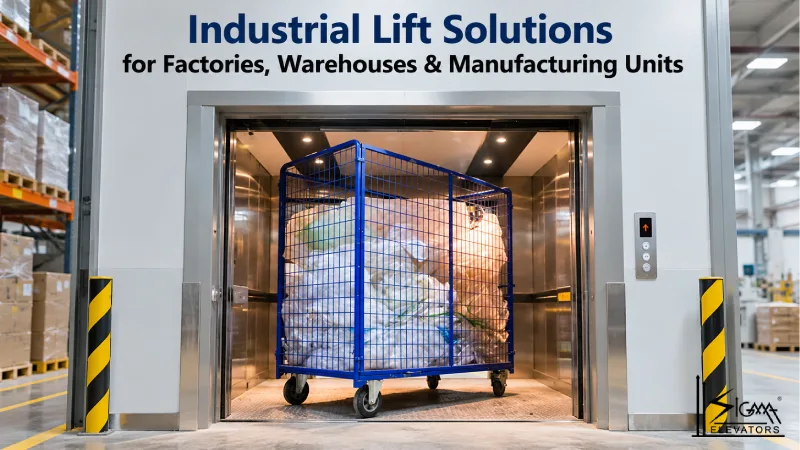
For facilities that regularly move bulky or heavy goods, freight elevators are a practical industrial solution. These lifts are intended for goods handling and can be configured according to the requirements of the installation.
Capacity, cabin size and loading requirements should be considered together when selecting a freight lift. The manufacturer’s published freight range includes different load capacities and cabin dimensions, allowing buyers to evaluate configurations based on their facility.
At Sigma Elevators, we provide freight elevator solutions for industrial applications where dependable vertical movement of goods is an important part of daily operations. Our product range also includes goods-cum-passenger and service lift options, giving industrial buyers more choice when planning vertical transportation.
Choosing the Right Lift for a Warehouse
Warehouses can have multiple storage levels, dispatch areas and loading points. The lift selected for such a facility should match the type and quantity of goods being transported as well as the physical layout of the building.
Before contacting Industrial Lift Manufacturers, businesses can review these points:
- Required load capacity
- Cabin width and depth for the goods being handled
- Number of floors or levels to be connected
- Available shaft and installation space
- Frequency of lifting operations
- Type of door and loading arrangement needed
Sigma’s freight elevator information also lists options such as collapsible gates, swing doors, multi-panel cabin doors and automatic doors, depending on the application.
Industrial Lift Features That Support Daily Operations
Industrial lifts need to work in demanding environments, so the configuration should reflect actual site conditions. Depending on the application, buyers may consider rugged cabin construction, suitable door arrangements, smooth leveling and indoor or outdoor installation options.
Sigma’s freight lift range includes sturdy cabin construction, auto-levelling, wide entrance options and indoor or outdoor models, with alternatives described for different operating environments.
Our broader elevator range includes hydraulic, traction, machine-roomless, gearless, freight, goods-cum-passenger and service lift solutions. This allows Sigma Elevators to address different vertical transportation requirements rather than treating every industrial site in the same way.
Industrial Lifts vs Passenger Elevators
The main difference comes down to the intended application. Passenger elevators are primarily designed for people, while freight and industrial-oriented solutions are selected around goods handling, load requirements and the operating environment.
|
Criteria |
Industrial/Freight Lift |
Passenger Elevator |
|
Primary use |
Goods and material movement |
People movement |
|
Load focus |
Heavy or bulky goods |
Passenger capacity |
|
Cabin design |
Application-focused |
Passenger comfort |
|
Door arrangement |
May support wider loading access |
Designed for passenger entry |
|
Typical locations |
Factories, warehouses, manufacturing units |
Offices, commercial and residential buildings |
For businesses evaluating Industrial Lift Manufacturers, this distinction helps narrow the product category before discussing technical specifications with a supplier.
Installation, Maintenance and Modernization
Selecting the lift is only one part of a long-term industrial lifting requirement. Installation quality, regular maintenance and future modernization also matter when a lift becomes part of the facility’s routine operations.
Sigma’s website lists installation, maintenance, modernization and complaint-handling services as part of its elevator service offering. It also states that the company manufactures and maintains a broad range of elevator systems.
A complete service approach can make industrial lift ownership easier to manage over time. For an existing installation, modernization may also be considered where components or systems need upgrading. Sigma states that it undertakes modernization for existing elevators, including systems from other brands.
Why Choose Us
Sigma Elevators brings experience across a broad elevator portfolio, including freight, goods-cum-passenger, service, hydraulic, traction and machine-roomless solutions. The company states that it was founded in 1985 and provides installation, maintenance and modernization services. Its website also identifies industrial projects within its project portfolio. For businesses seeking Industrial Lift Manufacturers, our approach is focused on matching the elevator type and configuration with the site’s practical requirements.
Conclusion
Industrial lifts are an important part of vertical material movement in factories, warehouses and manufacturing units. The right solution depends on load requirements, available space, goods dimensions, door configuration and the way materials move through the facility. Reviewing these factors before selecting Industrial Lift Manufacturers can help buyers choose a more suitable system for their application. Sigma Elevators offers a range of elevator solutions, including freight and goods-cum-passenger lifts for industrial environments.
Looking for a suitable industrial lift for your factory, warehouse or manufacturing unit? Talk to our team to discuss your application, lifting requirements and installation needs.
Call: +91 7383018998 Or Email: sales@sigmaelevators.in
Frequently Asked Questions
What are the key advantages of using industrial lifts in factories?
Industrial lifts streamline the movement of heavy goods, materials, and equipment across various levels within a factory. They contribute to enhanced productivity, reduce manual handling injuries, and ensure efficient workflow by connecting operational areas.
How do I choose the right industrial lift manufacturer for my facility?
When selecting industrial lift manufacturers, consider their experience, range of products, and ability to customize solutions based on your specific needs. Assess their service offerings, including installation and maintenance, to ensure long-term support for your lift system.
What are common applications for industrial lifts in warehouses?
In warehouses, industrial lifts are used for moving raw materials, transporting finished goods to storage areas, and facilitating connections between different levels. They are tailored to handle specific load requirements and configurations that match the warehouse's layout.
What distinguishes industrial lifts from passenger elevators?
Industrial lifts are designed specifically for moving goods and materials, whereas passenger elevators focus on transporting people. The design, load capacities, and door arrangements in industrial lifts are tailored to meet the demands of heavy-duty use in facilities like factories and warehouses.
What should I consider when evaluating industrial lift features?
Key features to consider include the lift's load capacity, cabin dimensions, installation space, and door configurations. Additionally, evaluate the lift's construction durability and the suitability for indoor or outdoor operation based on your specific application needs.